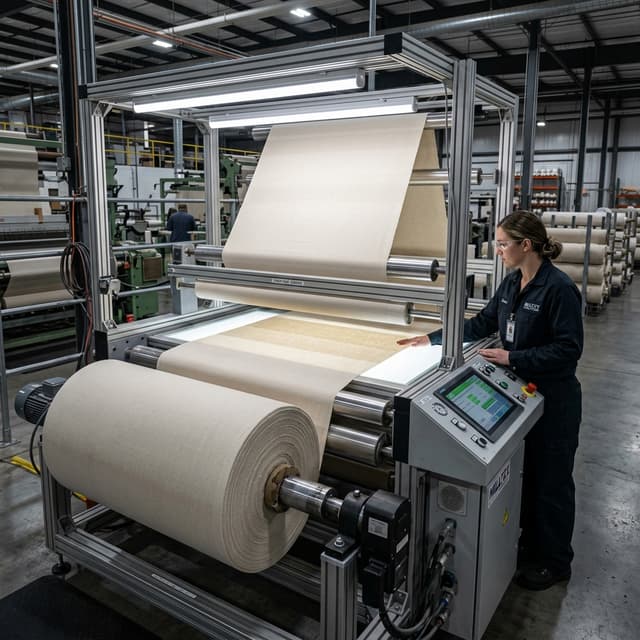
Buyers searching for polyester fabric suppliers in China hit the same wall: hundreds of companies, nearly identical product photography, and no reliable way to tell who actually weaves the cloth. Most listings are trading companies. A few are mills. The difference matters more than the quoted price, and it is verifiable before you commit money.
Here are the nine checks, in the order that eliminates the most risk fastest.
1. Ask for loom count and daily output in meters
Trading companies cannot answer this, because they do not own looms. A mill can answer immediately and specifically.
Weaverine runs 650+ waterjet looms with daily output above 200,000 meters and annual output of 73M+ meters. Those are the kind of numbers you can sanity-check: divide annual by daily, confirm the plant area matches the machine count, and ask whether looms are waterjet, airjet, or rapier, because that determines which constructions are possible at all.
A supplier claiming "large capacity" with no number attached is telling you nothing.
2. Request a factory audit report and look up its ID
This is the single highest-value check. An audit report has a unique ID that can be verified independently, and it is difficult to fabricate because a third party issued it.
A serious audit covers production capability, quality management, R&D, financial credit, working environment, and environmental management, with photographs from the floor. Some platforms let you purchase the full report from the supplier and check it independently before trusting it.
Weaverine passed the production-capability audit required for verified supplier status on the platforms where we hold it. That is a fact about our facility, not a ranking against anyone.
3. Confirm a certificate's scope, not just its existence
A certificate badge on a website proves that someone uploaded an image. It does not prove the certificate covers your product, your process, or your order.
The distinction that gets buyers into trouble:
- A Scope Certificate confirms a facility's certified production process. This is the one that tells you the mill itself is certified.
- A Transaction Certificate covers a single shipment. It says nothing about the standing of the mill behind it.
Weaverine holds a GRS Scope Certificate and OEKO-TEX certification. Confirm the certificate number directly with the issuing body, and check that the scope matches the product and process you are buying. Anyone who cannot produce a number you can verify is not offering you certification.
4. Ask for machine-level video, not marketing footage
Request a continuous walkthrough: loom hall, warping area, dyeing or finishing, roll packing, and loading. Continuous footage is hard to fake because the operator cannot stage every machine.
Look for looms running with fabric on them, material stacked in the correct order of the process, and lighting consistent across rooms. If you receive a three-slide photo set, ask for video instead.
5. Establish whether greige weight or finished weight is being quoted
This is where specifications quietly go wrong, and it is entirely avoidable.
A fabric has at least two legitimate weights: greige (after weaving) and finished (after dyeing, printing, or coating). Finishing changes the number, sometimes meaningfully. Softener, coating, embossing, and calendering all move it.
Weaverine quotes greige at 55–120 g/m² and finished at 60–140 g/m². Both are real. Mixing them on a purchase order is how a buyer receives cloth that fails their own specification on arrival.
Put the stage in writing: greige, semi-finished, or finished.
6. Get the width range and tolerance in writing
Width is a manufacturing constraint, not a preference, and it is usually the one that limits what you can order.
Weaverine weaves 160–330 cm on greige and 150–315 cm on finished cloth. A mill that quotes one wide number without naming the stage is compressing two different ranges into one.
Ask for a tolerance, not just a figure. Width within plus or minus 2 cm is a workable agreement on a wide cloth. Leaving it undefined means the acceptance decision becomes an argument later.
7. Read the minimum order quantity per color
"No minimum order" is a real and legitimate answer, but only for greige fabric already in stock. It is not a universal claim.
For a mill, the processes that create a cost center each have a batch size:
| Process | Typical minimum per color |
|---|---|
| Greige, stock specifications | None |
| Digital printing | None |
| Bleaching | ~2,000 m |
| Dyeing | ~3,000 m |
| Embossing | ~5,000 m |
| Rotary printing | ~5,000 m |
| Stain treatment | ~5,000 m |
The unit that matters is per color. A quote of "5,000 meters" without specifying per color can mean five thousand of one color or a hundred across fifty, and those are different orders entirely.
8. Test whether they push back on a bad specification
This is a behavioural check, and it is more reliable than any document.
Submit a specification that is technically achievable but commercially odd: an unusual construction, a tight tolerance combined with a small quantity, or a width at the edge of the range. A manufacturer with real experience will explain what it costs, what it risks, and what it would change. A trading company will simply quote it.
A supplier who agrees to everything is not evaluating your order. They are trying to win it.
9. Confirm the physical address, then verify it independently
Take the registered address and check it against a satellite view and a map listing. For a weaving mill, you should see a large industrial footprint, not a shop unit in a trading complex.
This step is worth doing precisely because it is easy to skip. A company in a multi-tenant commercial building presenting itself as a manufacturer is one of the most reliable red flags in this market.
What the answers should look like when you are ready
A supplier that passes all nine will give you, without being asked repeatedly: a machine count, a daily and annual output figure, a verifiable audit report ID, a certificate number you can check with the issuing body, continuous machine video, weight stated by stage, width with a tolerance, MOQ stated per color, and a registered address that matches their claim.
Weaverine publishes most of this already, across production capabilities, certifications, and greige fabric, because a supplier who will not state their own numbers is asking you to take the specification on faith. That is the whole test.