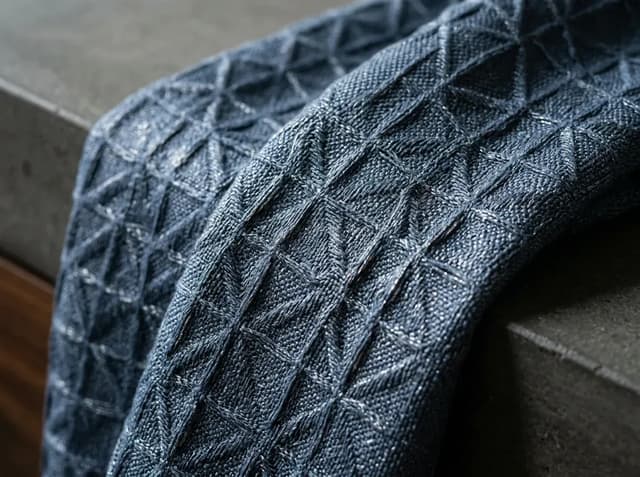
"Finish" is the most overloaded word in fabric buying. On one RFQ it means a softener, on the next an embossed texture, on the third a stain treatment - and on a fourth it means the print, which is not a finish at all. Most comparison pages online answer by listing finishes alphabetically, which is exactly why a buyer cannot compare two quotes: the list has no structure, and without structure there is nothing to compare against.
This page sorts the finishes a home-textile buyer actually chooses between into three families - mechanical, chemical, functional - says what each does to the cloth, how long each survives washing, and the test standard behind every durability figure. It is written from the finishing line of a mill that runs all of them, so every durability figure is one our own catalogue publishes and every standard is one we quote on spec sheets.
The three families, and what each does to the cloth
Mechanical finishes: structure, not treatment
A mechanical finish changes the cloth's surface physically. Nothing is added; the fibre itself is rearranged.
- Sanding and brushing - the peachskin route. Diamond-grit rollers shear the surface fibres into an ultra-short nap, under 0.2 mm, which is where the cotton-like hand comes from. Because the nap is fibre structure rather than a coating, it does not wash off; pilling is controlled by the sanding precision and tested to GB/T 4802, holding grade 3-4 on outgoing cloth.
- Embossing - heated engraved rollers at 180-220 °C press a pattern into thermoplastic polyester permanently. Pattern depth runs 0.5-3 mm on our floral program and 0.5-2 mm on the geometric one, and pattern definition is rated at 50+ wash cycles in the catalogue. Embossing consumes no water and no dye chemistry - the pattern is in the cloth, not on it.
- Calendering - the same heat-and-pressure principle with a smooth or patterned roller, used to flatten or glaze a face.
What the family means for the buyer: a mechanical finish is a permanent structure. Its durability question is not "does it wash out" but "does the structure hold up to abrasion" - which is why the test is a cycle count on pattern definition, not a chemical-retention figure.
Chemical hand finishes: the cloth feels different
A chemical hand finish deposits or modifies something on the fibre to change how the cloth feels.
- Softener - the standard hand modification, quoted on our softener-treated program with shrinkage under 3%. It is the finish behind "soft hand" on most bedding RFQs, and it is the one finish a PFD base must NOT carry, because a softener film blocks dye.
- Washed / enzyme treatment - the washed-cotton feel: enzyme processing relaxes the hand and pre-shrinks the cloth, quoted at shrinkage under 2% because the relaxation happens before the garment or article is cut.
What the family means for the buyer: hand finishes have no performance figure to compare - the comparison is the hand itself, on a sample, plus the shrinkage the treatment leaves the cloth with. The one hard rule is sequencing: a hand finish and a dyeing plan have to be ordered correctly, or the finish blocks the dye.
Functional finishes: a performance property, measured in wash cycles
A functional finish adds a property the base cloth does not have. This is the family where durability figures and test standards actually live, because the property has to survive laundering to be worth specifying:
| Finish | What it does | Durability (catalogue) | Test standard |
|---|---|---|---|
| C6 stain-resistant (three-defence) | Water, oil and soil repellency from a short-chain fluorochemical | 30+ washes; water repellency grade 4+ | Spray: AATCC 22 / ISO 4920; oil: AATCC 118 / ISO 14419; wash: ISO 6330 / AATCC 135 |
| Antibacterial + anti-mite | Inhibits bacterial growth and dust-mite colonisation | Antibacterial rate > 99%; anti-mite rate > 90% | Efficacy quoted per finish; confirm the test method on the spec sheet |
| Moisture-wicking | Moves perspiration off the skin and dries fast | Drying 50% faster than untreated | Wicking/drying quoted per finish; confirm the method |
| Wrinkle-resistant | Resin-free recovery so the cloth comes off the line wearable | Wrinkle recovery > 120° | Recovery angle quoted per finish |
| Insect-repellent | Repels mosquitoes and other insects on stored and outdoor textiles | 20+ washes | Durability quoted per finish; confirm the method |
| Water-repellent (DWR / PA route) | Sheds water; the PA-coating route adds a barrier backing | Quoted per route | Hydrostatic head ISO 811 where a barrier is specified |
Two disciplines make these figures comparable rather than decorative. First, the cycle count is a minimum against a named wash method - ISO 6330 or AATCC 135 at a stated temperature - so "30+ washes" means something only when the method is on the order. Second, the efficacy figure is initial performance; the durability figure is what survives. A finish quoted at "> 99%" with no cycle count has told you half of what you need.
Stain-resistant vs printed vs embossed: the category confusion, resolved
The prompt behind this section is a real RFQ mistake: three words that sound like parallel options but sit in different families.
- Stain-resistant is a functional finish - a C6 treatment on the base cloth, measured in wash cycles.
- Embossed is a mechanical finish - a heat-set texture, measured in pattern-definition cycles.
- Printed is not a finish at all. It is a colour route - digital, disperse rotary or pigment - that puts a design on the cloth. Our three print routes differ in fastness and cost: digital holds grade 4-5 with no printing minimum, disperse rotary grade 3-4 at production volumes, pigment grade 2+ as the budget route.
They compose, and that is the point. An embossed ground can carry a print; a printed panel can carry a stain-resistant finish; a peachskin base can be printed or piece-dyed. On the RFQ, name the base cloth, the colour route, and the finish as three separate lines - because they are three separate decisions with three separate minimums, and a quote that merges them is a quote you cannot compare.
What to specify on the RFQ
- The finish by family and name. "Softener" and "C6 stain-resistant" are both finishes; only one has a cycle count.
- The durability figure with its method. 30+ washes per ISO 6330 / AATCC 135 at 40 °C, or the equivalent you require - not "durable".
- The efficacy figure and what it measures. Water repellency grade 4+ on the spray test, antibacterial rate above 99% - and which standard each was measured to.
- The sequencing. A PFD base destined for piece dyeing must not carry a softener or a repellent; a finished panel can carry both.
- The route floor. Finishes are quoted per route on this mill: 5,000 m for most treatments, 2,000 m for bleaching, 3,000 m for solid dyeing, no minimum for digital printing.
Where to go deeper
The functional treatments each have their own page: C6 stain-resistant upholstery fabric carries the full surface-energy physics and the AATCC thresholds, functional fabric treatments walks the five treatment families, and the embossed fabric and peachskin term pages cover the mechanical routes. The finishes topic hub indexes the vocabulary, and the fabric durability tests guide separates the five tests that do not agree with each other.