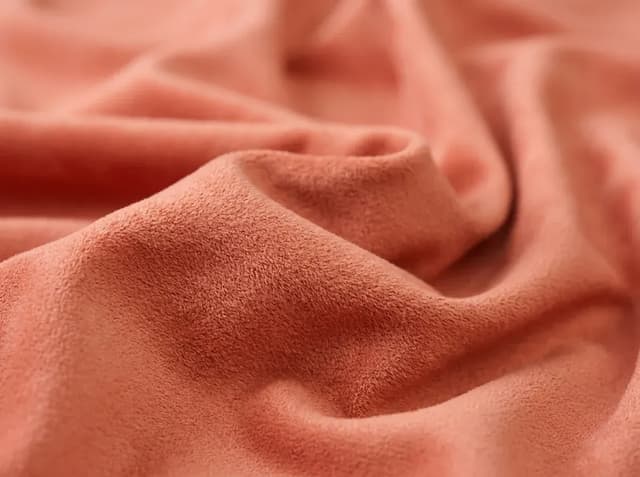
When private-label bedding brands, hotel linen converters, and home-textile importers source woven microfiber fabric or peach skin fabric, GSM (grams per square meter) is the single primary cost and quality driver on the purchase order. Yet buyers frequently discover too late that a 90 GSM sheet from one supplier feels crisp and opaque while a 90 GSM sheet from another feels limp, see-through, or pills after three washes.
At Weaverine, we weave 55–120 GSM loom-state polyester greige across 160–330 cm widths on 650+ high-speed waterjet looms, finishing bedding programs at 60–140 GSM across 150–315 cm usable widths. This guide breaks down how the four commercial bedding GSM tiers (70–80, 85–95, 95–110, and 110–120+ GSM) interact with filament count, weave structure, and peaching depth.
Why thread count fails on microfiber—and why GSM + DPF rules
In staple cotton sheeting, a 300-thread-count percale uses single-ply spun yarns whose diameter scales predictably with cotton count (Ne). In continuous-filament polyester, each warp and weft thread is a bundle of 36, 72, or 144 continuous micro-filaments:
75D/36F(2.08 DPF): Standard filament polyester (pongee / taffeta grade), not true sub-denier microfiber.75D/72F(1.04 DPF): Commercial microfiber workhorse for retail sheet sets and printed quilt shells.75D/144F(0.52 DPF): Ultra-fine micro-filament yarn with double the filament count at the exact same75Dyarn weight—delivering a buttery suede hand and higher opacity without increasing GSM.
You can verify the exact denier per filament (DPF) of any yarn callout with our Denier & DPF Calculator, and convert between roll width, linear meters, and bale weight using the Fabric GSM Calculator.
The 4 commercial microfiber bedding GSM tiers compared
| Finished GSM Tier | Typical Yarn & Weave Construction | Opacity in Optical White | Hand Feel & Thermal Profile | Target B2B Market & End Use |
|---|---|---|---|---|
| 70–80 GSM (Entry / Promo) | 50D/24F or 75D/72F × 75D/72F, 1/1 Plain Weave | Semi-translucent (dark pillow ticking shows through white shells; best for disperse/pigment prints) | Ultralight, quick-drying, high airflow; crisp or lightly peached | Promotional sheet sets, quilt backing, dorm bedding, budget e-commerce bundles |
| 85–95 GSM (Core Retail Standard) | 75D/72F × 75D/72F or 75D/144F, 1/1 Plain Weave (single- or double-side peached) | Good commercial opacity (standard pass for dyed & white retail sheets) | Soft diamond-emery suede hand; balanced year-round breathability | Mainstream Amazon/retail sheet sets, printed duvet covers, pillow shams |
| 95–110 GSM (Premium Retail & Hospitality) | 75D/72F × 150D/144F or dense 75D/144F, 2/1 Twill or Plain | Full opacity (masks patterned mattress pads and inner down-alternative comforters) | Plush, drapey, cotton-percale-like body; Grade 3.5–4.0 pilling test rating | Premium D2C bedding brands, 3- to 4-star hotel duvet shells, embossed geometric sets |
| 110–120+ GSM (Heavy Luxury & Satin Stripe) | 75D/72F × 150D/144F or 100D/36F, 3/1 Twill, 4/1 Satin, or Dobby Stripe | Maximum opacity | Substantial weight, warm winter hand or sleek hotel satin-stripe drape | Hospitality satin-stripe duvet covers, autumn/winter brushed collections, decorative shams |
How GSM interacts with pilling, seam slippage, and wash fastness
Specifying GSM in isolation creates three downstream quality traps if the weave density and finishing route are not matched to the weight:
- Under-constructed 85 GSM vs Properly Balanced 85 GSM: A mill can hit
85 GSMeither by weaving a tight75D/72F × 75D/72Fconstruction or by weaving an open, low-pick-count cloth using heavier150D/144Fweft yarns. The loose150D/144Fversion costs less loom time per meter, but fails seam slippage (ISO 13936) at the pillowcase closure and pills faster because long weft floats snag during laundering. - Diamond-Emery Peaching vs Wire Brushing: On 85–110 GSM bedding, Weaverine uses precision diamond-emery rollers (peach skin finishing) rather than steel-wire napping rollers. Diamond peaching raises a uniform
0.1–0.2 mmmicro-velour bloom that passes ISO 12945-2 (2,000 cycles) at Grade 3.5–4.0 (see our 3-way Peachskin vs Microfiber vs Brushed Polyester comparison). - Greige-to-Finished GSM Shift: During scouring, dyeing, and 180–200 °C stenter heat-setting, weft width contracts from 160–330 cm greige to 150–315 cm finished, concentrating GSM by +5% to +10% before sanding removes 2–4% surface dust. Model your exact greige-to-finished yield using our Shrinkage & GSM Calculator.
Extra-wide bedding widths: King and Cal-King without center seams
Standard apparel looms cannot weave seamless King-size sheet sets (275 × 260 cm flat sheet). Weaverine's wide-width waterjet looms weave 280 cm, 300 cm, and 315 cm finished widths, allowing bedding converters to cut Queen, King, and California King flat sheets, fitted sheets (with deep 40 cm pockets), and duvet shells seamlessly across the roll width.
B2B RFQ checklist for microfiber & peachskin bedding
When requesting a quote or pre-production lab dip from sales@weaverine.com or via /chat, include:
- Finished GSM and tolerance: e.g.,
90 GSM ± 3 GSMor105 GSM ± 4 GSM. - Yarn specification: e.g.,
75D/72F × 75D/72F(standard microfiber),75D/72F × 75D/144F(ultra-soft peached), or75D/72F × 150D/144F(heavy twill/peachskin). - Weave & surface finish:
1/1 plain,2/1 twill,4/1 satin, ordobby satin stripe;unbrushed flat,single-side carbon peached, ordouble-side peached. - Usable finished width: e.g.,
240 cm,280 cm, or300 cmcuttable width between pinholes. - Colouration & lab test gates: Optical white (MOQ 2,000 m), solid disperse dyed (MOQ 3,000 m, wash fastness Grade 4–5), rotary disperse/pigment print (MOQ 5,000 m), or digital print (no MOQ), with
<3%dimensional stability (ISO 6330).