Named-port Incoterm language for fabric POs. Weaverine is not a freight broker — confirm port, currency and risk transfer on the contract.
FOB Ningbo: What It Covers and Where Risk Passes
FOB Ningbo is Free on Board at the port of Ningbo: the seller's price normally covers loading the goods on board the vessel at Ningbo, and risk passes to the buyer from that point. The port name belongs in the contract.
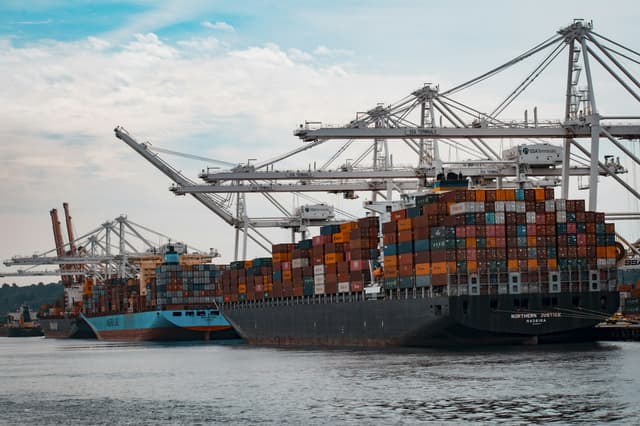
FOB Ningbo means Free on Board, Ningbo — the Incoterm where the seller's price normally runs until the goods are on board the vessel at Ningbo, and risk passes to the buyer from that moment. It is not a freight quote and not a warehouse location: it is a line on the contract that decides who pays for what after the truck leaves the mill.
Zhejiang's weaving belt — Changxing, Keqiao, Shaoxing — sits inland from the coast, and Ningbo-Zhoushan is the deep-water container port that serves it. So a mill quote in this cluster normally reads FOB Ningbo rather than FOB China: the port is named so that two mills can be compared against each other.
What FOB Ningbo covers
| Covered by the seller's FOB Ningbo price | Not covered — usually the buyer's |
|---|---|
| Inland trucking from the mill to the Ningbo terminal | Ocean freight beyond Ningbo |
| Export customs clearance and documentation | Marine insurance |
| Terminal handling to the vessel | Port charges after loading |
| Loading on board the named vessel | Delivery to the buyer's warehouse |
| Export packing as quoted on the PO | Destination duties and clearance |
The line is on board the vessel at the named port. Everything upstream of that is the seller; everything downstream is the buyer.
FOB Ningbo vs the alternatives
| Term | Where the seller's obligation ends | Use it when |
|---|---|---|
| FOB Ningbo | Goods on board the vessel at Ningbo | Sea shipment, and your forwarder knows the lane |
| FOB China | Unspecified — no port named | Never on a real PO; the quotes are not comparable |
| CIF | Goods on board at a named port, freight and insurance to destination | You want the seller to carry freight and cover risk to the quay |
| EXW | At the mill gate, before loading | You are collecting near the mill yourself |
| DDP | Delivered duty-paid to your door | Rare as a mill default; the seller carries almost everything |
Containers: why FCA often appears instead
FOB was written for break-bulk cargo loaded on board a vessel. A container is handed to the carrier at the terminal days before it sails — so under a strict reading of FOB, the risk point is on board a vessel the seller no longer controls. FCA passes risk when the carrier takes the container at the named terminal, which is how containers actually move.
This is not a technicality buyers argue about in good faith; it decides who pays if a container is damaged in the yard before loading. Ask your forwarder which term they are actually booking against.
What to write on the PO
- The port, spelled out: FOB Ningbo — not FOB China, not FOB origin
- The Incoterms year — Incoterms 2020 is current, and the year changes obligations
- Packing basis — rolls on pallets versus bales; it drives roll count and stuffing factor
- Container type and quantity — a 40-foot high cube takes a different number of rolls than a 20-foot
- Currency — FOB is a price term, not a currency term
- The roll specification itself: GSM, width and finish belong on the same document, because the freight and the fabric are priced in the same contract
Where Weaverine sits in this
Weaverine is a weaving mill in Changxing, Zhejiang. We price greige and finished polyester home textiles FOB Ningbo as the default, and we are not a freight broker: we do not quote the lane, book the vessel or arrange insurance. What we do is make sure the mill-side number on the PO is a real, comparable one — right port, right packing basis, right currency.
Read next: FOB for the full Incoterm, FCL and LCL for how the roll count turns into a booking, and how to source fabric from China for the whole route.
Common questions
What does FOB Ningbo mean on a fabric purchase order?
- It is the Incoterm Free on Board with Ningbo named as the port of shipment. The seller's price normally runs through loading the rolls on board the vessel at Ningbo; ocean freight, insurance and handling after that point are the buyer's, and risk passes when the goods are on board.
Is FOB Ningbo the same as FOB China?
- No, and the difference is practical rather than legal. FOB China names no port, so the quote cannot be compared like-for-like: inland trucking to the terminal, terminal handling and cut-off times all differ by port. A mill quoting FOB China is telling you the price stops somewhere in the country, not at a berth.
Why do container shipments sometimes use FCA instead of FOB?
- FOB is written for cargo loaded on board a vessel. A container is handed to the carrier at the terminal days before it ships, so under a strict reading of FOB the risk point sits on board a vessel the seller no longer controls. FCA passes risk when the carrier takes the container at the named terminal, which matches how containers actually move. Confirm which one your forwarder is booking against.
What else should a fabric PO state alongside FOB Ningbo?
- Name the Incoterms year (Incoterms 2020 is current), the port and berth basis, the packing basis (rolls on pallets or in bales), the currency, and the container type. Two quotes that differ only on packing basis are not comparable, and packing drives both the roll count and the stuffing factor.
Weaverine is in Zhejiang — why quote Ningbo?
- Ningbo-Zhoushan is the deep-water container port that serves Zhejiang's textile belt, including the Changxing and Keqiao weaving clusters. A mill inland from the coast trucks finished rolls to that port and ships from there, so Ningbo is the named port that makes our mill price comparable with another Zhejiang mill's.
Related Guides
Related Terms
Sourcing fob ningbo or a polyester equivalent? We quote mill-direct programs from 5,000 m per specification.
Want to learn more textile terms?
Browse the full glossaryPolyester home-textile fabric, woven mill-direct for buyers worldwide.
Our mills run 650+ waterjet looms and produce 73M+ meters annually for bedding, curtain, and upholstery fabric programs.