Fleece is knitted, so it needs a knitting machine. This mill weaves on 650+ waterjet looms; a brushed woven hand is the closest it can honestly quote.
Fleece
A raised pile cloth, usually a weft-knitted polyester that is brushed on both faces and then sheared. Weaverine does not knit; a polyester buyer arriving with a fleece brief is pointed to brushed woven peachskin instead.
By Wren Thunderborn, Head of Content
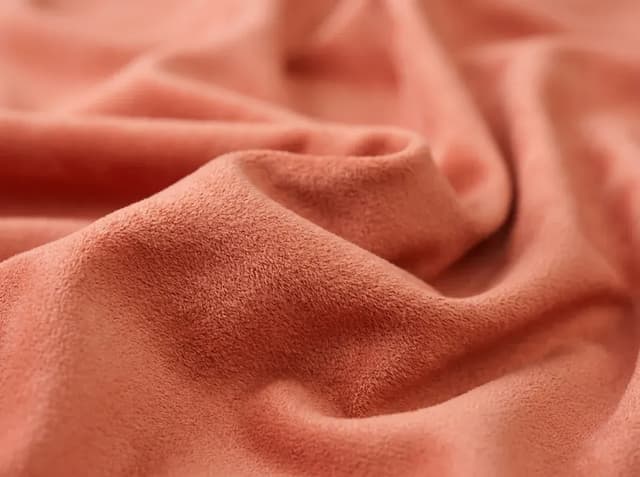
Fleece is a knitted pile cloth, not a weave. That single fact decides the whole conversation: it is built from interlocking loops on a knitting machine, then brushed and sheared to a soft, warm face. A weaving mill has no knitting machine, so it cannot quote fleece — and says so.
What a weaving mill can quote is the nearest honest hand: a woven polyester plain cloth, sanded to a nap, which is peachskin and brushed fabric at 75–120 GSM. Soft, matte, warm to the touch and stable in a panel. Not fleece; often the right answer for bedding, curtains and linings where fleece is the wrong cloth anyway.
One word, three different cloths
The confusion starts here, and it is worth settling before a spec is written.
| What people mean | What it is | Made by |
|---|---|---|
| Sheep fleece | The raw wool shorn from a sheep, before spinning | A farm, then a spinner |
| Cotton / sweatshirt fleece | A knitted cotton or blend cloth with a looped, raised back | A knitter |
| Polar fleece / microfleece | Knitted 100% polyester, brushed both faces, sheared | A knitter |
Only the last two are fabrics, and both are knit. If a purchase order says "fleece" with no further detail, the mill cannot know which of the three is meant — which is exactly why the line needs rewriting.
How knit fleece is made, and why a loom cannot
The route is short and machine-specific:
- Knit the loop structure. Polyester filament is knitted into a looped ground on a circular or flat knitting machine. The loops are what trap air and give the stretch.
- Brush both faces. Wire-covered rollers pull fibre ends up out of the surface, creating the pile.
- Shear to an even height. A cutting pass trims the nap flat so the cloth has a uniform face rather than a shaggy one.
- Set and finish. Heat setting stabilises the dimensions; an anti-pill finish may follow.
A waterjet loom interlaces warp and weft at right angles. There are no loops in that structure, so there is nothing for a brush to raise in the same way and no knit stretch to recover. This is a machine boundary, not a skill boundary — the same reason a knitter cannot weave a taffeta.
The weights, and what each one is for
Fleece is sold by weight, and the band tells you the job:
| Band | Typical GSM | What it is for |
|---|---|---|
| Microfleece | 100–200 | Linings, light mid-layers, travel throws |
| Standard polar fleece | 200–300 | Mid-layers, jackets, blankets |
| Heavy polar / sherpa-type | 300–400+ | Outer layers, deep-pile throws |
Those are market bands for knitted fleece, not this mill's range. For comparison, this mill's woven output is greige 55–120 GSM, finishing at roughly 60–140 GSM — a different world of weight, because a knit traps air in a way a plain weave does not.
What a woven mill answers instead
If the requirement is "soft brushed polyester", here is the honest mapping:
| The fleece brief | The woven answer | The trade |
|---|---|---|
| Brushed, warm hand | Peachskin, 75–120 GSM, sanded in-house | Less loft; no knit stretch |
| Light lining with a nap | Brushed plain weave at 60–75 GSM | Thinner; drapes rather than stretches |
| Throw or blanket warmth | Woven brushed at the top of the band, or a different supplier | A woven cloth at 140 GSM will not equal 300 GSM fleece |
| Anti-pill face | Sanded woven with a shearing pass, graded to a standard | Different test basis from knit fleece |
The honest line: if the end product is outerwear, a sleeping bag or a deep-pile throw, fleece is the right cloth and it should be bought from a knitter. If the end product is bedding, a curtain, a lining or a quilted panel — where stability, flat seams and a straight edge matter more than loft — a brushed woven cloth is usually better and this mill can make it.
Why woven wins where the end use is a panel
Three practical differences, all of them the buyer's problem rather than the mill's:
- Edge behaviour. A knit fleece curls; a woven brushed cloth cuts and sews flat, which matters on a curtain drop or a quilted panel edge.
- Loop failure. A pulled knit loop can run. A woven ground locks its yarns, so a snag stays local.
- Dimensional stability. A woven polyester plain cloth holds width and length through washing, with shrinkage held under 3% on a heat-set finish. A knit recovers and relaxes differently in each direction.
None of that makes fleece a worse cloth. It makes it a cloth for different products.
What goes on the order
Whether the answer is fleece or a woven substitute, the line has to say which:
- The construction, not the word — "knitted brushed pile" or "woven plain, brushed face".
- Fibre and weight — 100% polyester, and the GSM with its tolerance.
- The face — single-sided or double-sided brush, and the pile height.
- The pill standard, named, so the face is testable rather than promised.
- The end use — garment, throw, bedding, curtain — because that decides which construction is correct.
- For a woven substitute: greige or finished GSM, cuttable width, and the finishing route.
What this mill does
There is no fleece here, and it is not a gap in capability: it is a different machine. This mill weaves 100% polyester on more than 650 waterjet looms — greige at 55–120 GSM and 160–330 cm, finished at 60–140 GSM and 150–315 cm, above 200,000 m/day — and brushes its own cloth in finishing.
What is this mill's, for a brief that arrives with the word "fleece":
- Peachskin — sanded woven polyester, 75–120 GSM, the standard bedding and soft-hand programme.
- Brushed fabric — the mechanical finish itself, applied to woven plain cloth on the same site.
- Microfiber — finer filament, denser hand, when the brief is "soft and dense" rather than "fluffy".
- Pilling test — the standard the anti-pill claim is graded against, so the face is specified rather than assumed.
Stock greige carries no minimum; custom greige starts at 5,000 m and piece dyeing at 3,000 m per colour. For a programme question, request a quote; for the base cloth every programme starts from, see greige fabric.
Common questions
What is fleece fabric?
- A pile cloth with a raised, soft face, almost always knitted. Polyester fleece is a weft-knitted loop structure that is brushed on one or both faces and then sheared to an even height. The knit gives it stretch and loft; the brushing gives it the warm, matte hand. It is a garment and throw cloth rather than a bedding or curtain cloth.
What is fleece made of?
- Three different things, which is why the word confuses buyers. Sheep fleece is the raw wool shorn from an animal. Cotton fleece and sweatshirt fleece are knitted cotton or cotton-blend cloths with a looped, raised back. Polar fleece and microfleece are knitted 100% polyester, brushed both sides and sheared, and that is what a spec sheet usually means today.
Is fleece knitted or woven?
- Knitted, in every commercial form. Fleece is built from interlocking loops on a circular or flat knitting machine, which is what gives it stretch and the loft that traps air. A woven cloth cannot be fleece: interlaced warp and weft do not form those loops, so a brushed woven fabric is a nap cloth, not a fleece.
Can you get a brushed polyester that is not knitted?
- Yes, and it is the honest substitute. A woven polyester plain cloth can be sanded or brushed to raise a nap, giving peachskin and brushed fabrics at 75–120 GSM with a soft, matte face. It has no knit stretch and less loft than polar fleece, but it does not curl at the edges, does not run if a loop is pulled, and holds a panel shape for bedding and curtains.
Why does fleece pill?
- Because brushing cuts fibre ends loose on the surface, and knit loops let short fibres migrate. Anti-pill fleece is controlled by using a finer denier, a tighter knit and a post-brush shearing pass, and it is graded to a standard rather than promised. On a brushed woven cloth the same risk exists but is easier to hold, because a woven ground locks the yarn more firmly than a knit loop does.
Is fleece waterproof or breathable?
- Neither, by itself. Fleece is hydrophobic and keeps some warmth when damp, but it is not a barrier fabric and it is not windproof; water passes through the pile. Breathability comes from the air in the loft and a knit that lets vapour move, which is why fleece is normally used as a mid-layer. A waterproof claim needs a coating or laminate, which is a different product.
Related Terms
Sourcing fleece or a polyester equivalent? We quote mill-direct programs from 5,000 m per specification.
Want to learn more textile terms?
Browse the full glossaryPolyester home-textile fabric, woven mill-direct for buyers worldwide.
Our mills run 650+ waterjet looms and produce 73M+ meters annually for bedding, curtain, and upholstery fabric programs.