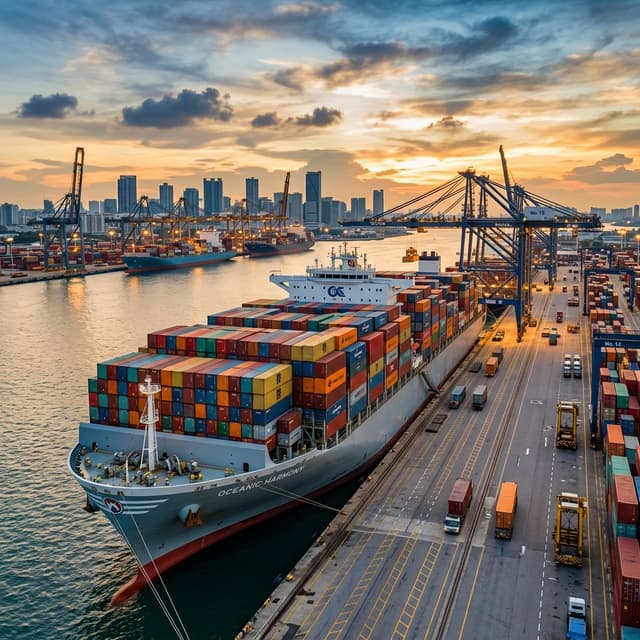
Two terms sit on most fabric purchase orders from a Chinese mill, and they differ by about two hundred metres and one document. FOB (Free on Board) means the mill's responsibility ends when the goods are on board the vessel at the named port — usually Ningbo for us. FCA (Free Carrier) means it ends earlier, at the origin terminal, when the goods are handed to the carrier. Everything downstream of that handover point — the ocean leg, the insurance, the terminal costs, the document your bank will accept — is decided by which of the two you write on the PO.
For polyester fabric the difference is not academic. Fabric is bulky relative to its weight, so a container cubes out long before it weighs out, and the loading is a crane operation at a shared terminal rather than something the mill does at its own gate. That single fact is why the terms behave differently on a roll of fabric than they do on, say, a pallet of fasteners.
| FOB (Free on Board) | FCA (Free Carrier) | |
|---|---|---|
| Delivery point | Goods on board the vessel at the named port | Goods handed to the carrier at the named place, e.g. the terminal gate |
| Transport modes | Sea and inland waterway only | Any mode: sea, air, road, rail |
| Who loads the container | The seller, onto the vessel | The terminal, from the seller's delivery |
| When risk passes to the buyer | On board | At delivery to the carrier |
| Export clearance | Seller | Seller |
| Main carriage to your country | Buyer | Buyer |
| Insurance | Buyer, from the port of loading | Buyer, from the named place |
| Document the buyer holds | Bill of lading showing on-board loading | Terminal or carrier receipt; the B/L goes to the forwarder |
| Where the origin terminal charge lands | Commonly on the buyer's invoice | Inside the seller's scope up to the named place |
| Best fit | Breakbulk, and buyers with their own forwarder and vessel booking | Containers, air freight, and buyers who want a named handover point |
When each side fits
FOB fits when the buyer has a forwarder who books the vessel and wants the mill to load the cargo on board. It is the traditional basis for Chinese textile exports, it matches the way most mills quote, and it leaves the buyer with full control of the ocean leg and the carrier. It is also the right term for breakbulk cargo — a pallet, a roll, a crate that is loaded as an individual piece.
FCA fits when the cargo goes in a container. The Incoterms® rules recommend it for containerized shipments because the terminal's equipment loads the box, not the seller, and the risk moment of "on board" sits in a queue at the terminal. Handing the container over at the terminal gate names the point exactly, and it keeps the terminal's handling charge inside the price the buyer negotiated. It is also the term for air freight and for road or rail movement, where FOB does not apply at all.
Neither is a quality signal. A mill quoting FCA is not more reliable than a mill quoting FOB. The term decides where the risk sits and who pays for the handling; it says nothing about the fabric, the finish, or the tolerances.
The other three terms you will be asked about
The comparison usually starts with FOB and ends with one of the other three. Here is where each one sits against the two above, and what it means when the mill is the one quoting.
| Term | Delivery point | Who arranges the main carriage | What it means for a Weaverine order |
|---|---|---|---|
| EXW | The mill gate | Buyer, from the gate | The buyer takes the inland leg and the export clearance, so it only makes sense with a forwarder already working in Ningbo. We are a mill, not a freight broker, so we do not quote inland transport. |
| FOB | On board at the named port | Buyer | Our default basis. The quote names the port — FOB Ningbo for most programs — and the vessel nomination and freight stay with the buyer. |
| FCA | At the named terminal | Buyer | Ask for it on the RFQ and name the terminal; the delivery point is then priced into the quote. |
| CIF | On board, plus freight and insurance to the destination port | Seller | We can quote CIF for agreed ports. The buyer loses the freedom to choose the carrier, which is the point of the term. |
| DDP | Door to door | Seller | We can quote DDP for agreed destinations, per destination, because duty rates and customs rules differ by country and the seller carries that cost and the clearance. |
Whichever term you land on, the price still depends on the same variables: width, GSM, weave, finish, monthly meters, packing and Incoterm. Confirm the full spec before you compare two offers — a quote that names only the Incoterm is not comparable with one that names the fabric.
Why the loading point matters more for textiles
Polyester fabric rolls are bulky relative to their weight. A standard roll of peachskin at 150 cm width and 1,500 meters measures roughly 0.35–0.5 CBM but weighs only 100–150 kg, so a container fills by volume long before it reaches its payload limit. That has two consequences for the term you sign:
- Void space is decided at the terminal, not at the mill. We produce fabric from 160 cm to 330 cm, and wider fabric gives a larger roll diameter, which leaves more space between rolls and cuts the meters per container. The container plan has to be agreed before the booking, not at the loading gate.
- The loading itself is a shared-terminal operation. Under FOB the seller is responsible for getting the goods on board, which in practice means handing them to the terminal. Under FCA that handover is the delivery, and it is the documented moment the risk moves.
| Container type | Internal volume | Max payload | Typical fabric capacity |
|---|---|---|---|
| 20' Standard | ~33 CBM | ~21,700 kg | 40,000–60,000 meters |
| 40' Standard | ~67 CBM | ~26,500 kg | 80,000–130,000 meters |
| 40' High Cube | ~76 CBM | ~26,300 kg | 100,000–150,000 meters |
If you are still deciding how much to ship rather than on which term, FCL vs LCL for fabric covers the cost crossover and the container math. If you are new to the whole chain, how to source fabric from China walks the order from the RFQ to the container.
What to write on the PO
Six items make the term enforceable, and only the first two are about FOB or FCA:
- The Incoterm and its named place —
FOB Ningbo,FCA Ningbo (terminal named). A term without a place is not an Incoterm. - The edition of the rules —
Incoterms® 2020on the contract and the commercial invoice, so the test for who pays what is the one the buyer thinks it is. - The currency and the price basis — USD per linear meter on the agreed volume band.
- The roll spec — width, GSM, weave, finish and the order volume, so the two offers are comparable.
- The document set — commercial invoice, packing list with roll-level detail, certificate of origin, and the bill of lading or terminal receipt that the chosen term produces. Add a GRS transaction certificate when the lot claims recycled content.
- Payment terms — and, if the buyer is paying by letter of credit, the term that matches the document the bank will accept.
One line to paste into the RFQ:
Incoterm: FOB Ningbo (Incoterms® 2020) — risk passes on board at Ningbo; vessel nomination and ocean freight by the buyer. Or: FCA Ningbo, [terminal name] (Incoterms® 2020) — risk passes at the terminal gate, origin terminal charges in the mill price.
When to ask for which term
- Trial orders and samples — the volume does not fill a container, so the mode matters more than the term. See FCL vs LCL for the crossover.
- First container programs (5,000–20,000 meters) — quote both FOB and FCA from your forwarder and compare the origin cost sheets. The fabric is the same; the difference is a handling charge and a document.
- Recurring programs (20,000+ meters per order) — FOB with a forwarder who books the vessel, or FCA with a forwarder who takes the container from the terminal. Both are routine; what matters is that the same term appears on the PO, the invoice and the booking.
- Air shipments and samples — FOB does not apply to air or road movement. FCA is the term that covers them.
Ready to put a term on your next order? Send the meters, width, GSM and finish, and we will quote the Incoterm you name with the spec behind it — or use our AI Assistant for a quick estimate of volumes, CBM and lead time.