Acrylic is spun from cut staple like wool, and this mill weaves filament polyester. The polymer differs and so does the fibre form, which is why a wool-like bulk cannot be woven here.
Acrylic
A synthetic fibre of at least 85% acrylonitrile, spun as staple like wool — soft, bulky and warm for its weight. Weaverine weaves filament polyester, so acrylic is both a different polymer and a different fibre form; what the mill can answer is the soft warm hand and the bright cationic shades.
By Wren Thunderborn, Head of Content
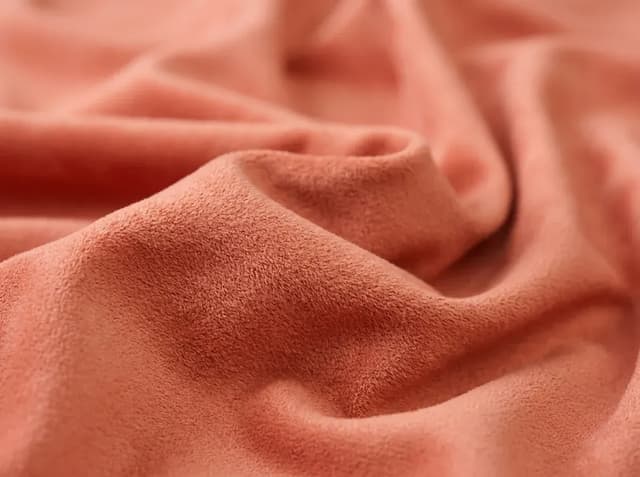
Acrylic is polyacrylonitrile, spun as staple. Two words in that sentence carry the whole distinction from polyester, and buyers usually conflate them: it is a different polymer, and more importantly it is a different fibre form.
Most acrylic is extruded as continuous tow, cut into short staple, and spun the way wool is spun. That is why acrylic cloth is bulky, soft and warm rather than smooth and cool. This mill weaves filament polyester — continuous yarn, no spinning step — so the gap is not only chemistry but form. A wool-like bulk cannot be woven from a filament.
One word, three different things
Worth separating before any specification, because the industry uses the word loosely:
| What is meant | What it is | Where it turns up |
|---|---|---|
| Acrylic fibre | ≥85% acrylonitrile copolymer, staple-spun | Knitwear, blankets, fleece, socks, fake fur |
| Modacrylic | 35–85% acrylonitrile plus FR comonomers (often vinylidene chloride) | Protective clothing, contract furnishings, fake fur — inherently flame resistant |
| Acrylic binder / coating | An acrylate polymer dispersion — a different chemistry family entirely | Backcoatings and binders, including blackout foam |
That third row is not a fibre at all, and it is a frequent source of confusion in technical packs: an "acrylic backing" on a blackout fabric is a coating chemistry, unrelated to an acrylic sweater.
What acrylic is genuinely good at
Being fair to the fibre makes the substitution advice usable:
- Warmth for weight. Acrylic traps air in a bulky spun structure, so a light acrylic feels warmer than the same weight of flat polyester.
- Wool-like softness at a fraction of the cost, with none of wool's felting or moth risk.
- Quick drying — regain is low and it sheds water fast.
- Brilliant colour. Acrylic takes cationic (basic) dyes, which give deep, saturated shades at low temperature. This is its strongest commercial argument.
- Solution-dyed acrylic for outdoor use — pigment spun into the polymer, so it holds colour in sunlight where dyed cloth fades. That is the awnings and marine-cover market.
Where it fails
- Pilling. The defining weakness. Staple fibres with low flex resistance work loose and ball up rather than breaking away. It is structural, not a finishing fault.
- Dimensional instability. Acrylic stretches and does not always recover; a garment loses shape.
- Low abrasion resistance, so cuffs, seats and stress points wear first.
- Static and heat sensitivity — it softens at a low temperature, so pressing is risky.
Acrylic vs polyester, on the rows that matter
| Property | Acrylic (PAN) | Polyester (PET) |
|---|---|---|
| Typical fibre form | Staple, spun | Filament, continuous |
| Hand | Bulky, soft, wool-like | Smooth, cool, dry |
| Warmth per gram | Higher (via bulk) | Lower |
| Pilling | Poor | Good |
| Abrasion | Low | High |
| Dimensional stability | Poor; stretches | High; heat-settable |
| Colour intensity | Excellent via cationics | Good; cationic-dyeable grades match it |
| Sunlight (dyed goods) | Fades unless solution-dyed | Stable |
| Cost | Low | Low |
Two of those rows decide most programmes: fibre form (bulk vs smooth) and pilling. Everything else can be engineered on either side.
What polyester answers, and what it cannot
A brief that says "acrylic" usually means one of four things. Three are answerable:
| What the buyer actually wants | The polyester answer | What is lost |
|---|---|---|
| A soft, warm, matte hand | Peachskin, brushed woven, 75–120 GSM | The bulky loft of a spun yarn |
| Bright, deep, saturated colour | Cationic-dyeable polyester — the same cationic dye class, without the pilling | Nothing on colour; loses the wool-like bulk |
| Flame resistance (the modacrylic case) | Flame-retardant polyester, by additive or comonomer | An inherent mechanism becomes an engineered one; the standard must be named |
| Wool-like bulk and loft | Nothing. This mill weaves filament | This is the boundary |
That third row deserves its own sentence, because it is where specifications go wrong most often. Modacrylic is inherently flame resistant; FR polyester achieves a rating by chemistry added to the polymer or the finish. Both can pass a standard, but the mechanisms differ, so the standard and the test method belong on the order — not the fibre name.
What goes on the order
- The property, not the fibre word — soft warm hand, colour depth, flame standard, or bulk.
- The fibre form — filament or spun — because that is what sets the hand.
- The GSM and the finish, since a brushed face and a calendered face read as different cloths.
- The colour method — dyed, cationic, or solution-dyed — because it decides the fastness, especially to light.
- The flame standard and test method if flame resistance is the requirement.
- The wash regime, so pilling and dimensional change are judged against real laundering.
What this mill does
There is no acrylic here, and the limit is the fibre form as much as the polymer. This mill weaves filament 100% polyester on more than 650 waterjet looms — greige at 55–120 GSM and 160–330 cm, finished at 60–140 GSM and 150–315 cm, above 200,000 m/day. There is no staple spinning line, so a spun bulky hand is not something this mill can produce.
What it can quote for an acrylic brief:
- Peachskin — brushed woven, the soft warm matte hand.
- Cationic polyester — deep, vivid shades via the same cationic dye class, and two-tone effects in a blend.
- Flame-retardant polyester — for the modacrylic role, with the standard named.
- Fleece — where the brief is a brushed pile and a knit would be the real answer, the page on that term says so.
Stock greige carries no minimum; custom greige starts at 5,000 m and piece dyeing at 3,000 m per colour. Request a quote with the property and the standard, or see polyester fibre for the fibre the mill runs.
Common questions
What is acrylic fabric made of?
- Polyacrylonitrile — at least 85% acrylonitrile units in a copolymer. It is extruded as continuous tow, then cut into staple and spun into yarn the way wool is spun, which is why acrylic cloth is bulky and soft instead of smooth. That two-step route, not just the chemistry, is what gives acrylic its wool-like hand.
Is acrylic a plastic?
- Technically yes — it is a synthetic polymer, so the fibre is a plastic in the material sense. But "plastic fabric" is a poor guide to behaviour: acrylic is spun into a soft bulky yarn, not extruded into a film, and it behaves like a wool substitute in a garment. The useful question is not whether it is plastic but which polymer and which fibre form.
What is the difference between acrylic and polyester?
- Three differences matter. Polymer: acrylic is polyacrylonitrile, polyester is PET. Fibre form: acrylic is almost always staple-spun (bulky, hairy, wool-like), polyester is usually filament (smooth, continuous). Performance: acrylic is warmer for its weight and softer, but pills badly, stretches, and has poor abrasion; polyester is stronger, more dimensionally stable, and holds heat-setting. Acrylic also takes cationic dyes brilliantly.
Why does acrylic pill so much?
- Because it is a staple yarn with low fibre strength and low flex resistance, so short fibres work loose from the yarn and ball up on the surface instead of breaking away. Pilling is acrylic's defining weakness and it is structural, not a finishing fault: a brushed acrylic will pill no matter how well it is finished. An anti-pill finish slows it; it does not stop it.
What is modacrylic, and is it flame retardant?
- Modacrylic is the same fibre family with the acrylonitrile content reduced to between 35% and 85% and flame-retardant comonomers added, usually vinylidene chloride. That makes it inherently flame resistant, which is why modacrylic is used in protective clothing, fake fur and contract furnishings. It is a genuinely different product from ordinary acrylic, not a finished version of it.
What is the best polyester substitute for acrylic?
- Name the property first. For a soft warm matte hand, brushed woven peachskin at 75–120 GSM. For bright, deep shades — acrylic's best argument, since it dyes with cationics — cationic-dyeable polyester gives the same colour intensity without the pilling. For the flame-retardant role of modacrylic, flame-retardant polyester works by a different mechanism, so the standard has to be named. What polyester cannot do is imitate spun-staple bulk.
Related Terms
Sourcing acrylic or a polyester equivalent? We quote mill-direct programs from 5,000 m per specification.
Want to learn more textile terms?
Browse the full glossaryPolyester home-textile fabric, woven mill-direct for buyers worldwide.
Our mills run 650+ waterjet looms and produce 73M+ meters annually for bedding, curtain, and upholstery fabric programs.