Denier
A unit of measurement for the linear mass density of fibers, defined as the mass in grams per 9,000 meters of fiber.
Denier fabric meaning: denier (D or den) is yarn or fiber fineness—grams per 9,000 meters of the strand. About 1 g / 9,000 m is 1 denier. Lower denier is finer; higher is coarser. It is not GSM (grams per square meter of cloth). A fine yarn can still make a heavy fabric if sett changes.
Denier vs GSM
Denier describes the yarn. GSM describes the cloth. Both belong on the PO. A fine filament in a dense sett can outweigh a coarser yarn in an open sett. Labels such as 20D fabric are still yarn denier, not cloth weight—confirm GSM separately.
Yarn fineness vs cloth weight
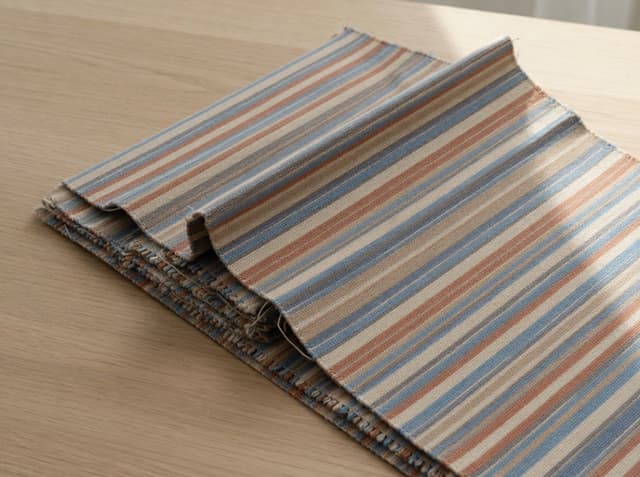
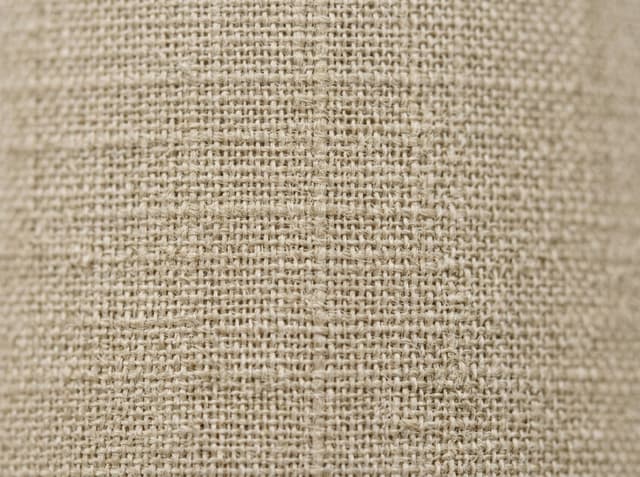
The stripe photo shows yarn as a visible thing. The cloth photos are GSM — mass per square meter.
01Yarn (denier)
Grams per 9,000 meters of the strand. Warp and weft can differ.
 02
02Cloth (GSM)
Mass of one square meter. Sett and finish move this number.
| Field | Measures | Unit | Common mix-up |
|---|---|---|---|
| Denier | Yarn / fiber fineness | g / 9,000 m | “20D fabric” is still yarn, not cloth weight |
| GSM | Cloth area weight | g/m² | A fine yarn in a dense sett can still be heavy |
Formula and dtex
D = (mass (g)) ÷ (length (m)) × 9000
European specs often use decitex (dtex)—grams per 10,000 meters. Conversion:
D = dtex × 0.9
Confirm which unit the counterparty wrote.
Typical ranges (illustrative)
| Denier | Classification | Typical applications |
|---|---|---|
| < 1 | Microfiber | Soft bedding hand, high surface area |
| 1–3 | Fine | Fine polyester filaments, silk-like programs |
| 3–6 | Medium | Standard polyester home-textile yarns |
| 6–15 | Coarser | Heavier duty cloths |
| > 15 | Very coarse | Industrial / technical (program-specific) |
Microfiber is commonly defined as below 1 denier. These bands are neighborhoods, not pass/fail limits for every home-textile program.
What to put on the PO
- Yarn denier (or dtex) for warp and weft if they differ
- Fiber type and filament vs spun if relevant
- GSM, width, weave/sett in the same line—denier alone does not freeze fabric weight
- End use / hand target so “fine denier” is not substituted without sample approval
Pair denier with thread count and GSM when the construction must be reproducible across mills. How denier plays out in yarn buying: polyester yarn denier guide.
Spec tools
Common questions
What does denier mean in fabric?
- Denier (D or den) is yarn or fiber fineness: grams per 9,000 meters of the strand. Lower denier is finer. It is not the same as GSM.
Is 20D fabric a cloth weight?
- No. Labels such as 20D fabric are yarn denier, not cloth weight. On Weaverine greige programs (55–120 GSM, 160–330 cm) both numbers belong on the PO — confirm denier and GSM separately.
How do you convert denier to dtex?
- Denier equals dtex times 0.9, because dtex is grams per 10,000 meters.
Related Terms
Sourcing denier or a polyester equivalent? We quote mill-direct programs from 5,000 m per specification.
Want to learn more textile terms?
Browse the full glossaryPolyester home-textile fabric, woven mill-direct for buyers worldwide.
Our mills run 650+ waterjet looms and produce 73M+ meters annually for bedding, curtain, and upholstery fabric programs.