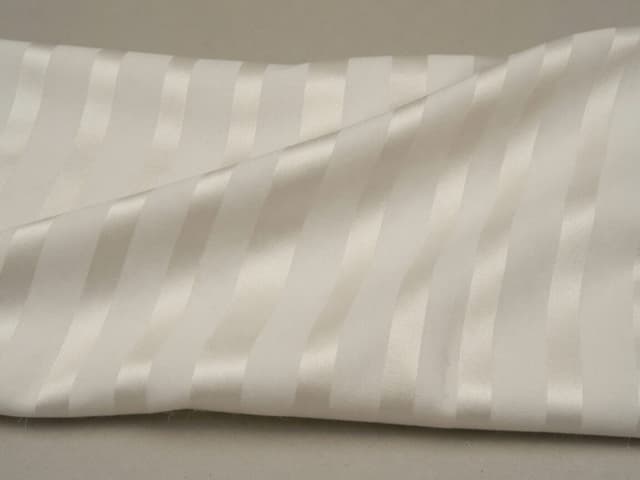
Hospitality linen buyers, commercial laundries, and bedding converters evaluate sheeting on four operational numbers: fabric weight (GSM), cuttable roll width (240–315 cm), optical whiteness (CIE 120+), and dimensional stability across repeated tunnel-washer and calendar cycles.
While luxury heritage properties specify 100% cotton percale or poly-cotton blends for skin-first breathability, 100% filament polyester dominates high-turnover hospitality, resort, cruise, healthcare, and institutional bedding programs where fast drying, wrinkle recovery, and zero-shrinkage repeatability govern total cost per occupied room.
Weaverine weaves 100% polyester bedding grounds on 650+ waterjet and dobby looms across 160–330 cm greige widths (150–315 cm finished) and 55–120 GSM greige (60–140 GSM finished). Below is the complete specification matrix to put on a hospitality RFQ.
1. Core Hospitality Bedding Constructions Compared
Every hotel linen tier maps to a specific weave, yarn denier, and finishing route:
| Hospitality Program | Typical Finished GSM (oz/yd²) | Typical Yarn & Weave | Finished Cuttable Width | Key Performance Spec | Mill MOQ & Route |
|---|---|---|---|---|---|
| Dobby Satin Stripe | 110–140 GSM (3.24–4.13 oz/yd²) | 75D×150D or 150D×150D warp/weft dobby | 240–315 cm (94–124 in) | 1 cm, 2 cm, or 3 cm woven alternating lustre bands; CIE 120+ white | 5,000 m (Satin Stripe) |
| Bleached White Plain / Twill | 90–130 GSM (2.65–3.83 oz/yd²) | 75D×150D or 100D×150D plain / 2/1 twill | 150–315 cm (59–124 in) | High optical brightness (CIE 120+); smooth unbrushed face | 2,000 m (Bleached White) |
| Brushed Microfiber / Peachskin | 85–110 GSM (2.51–3.24 oz/yd²) | 75D/72F × 150D/144F (DPF ≈ 1.04) plain / twill | 160–315 cm (63–124 in) | Carbon-bristle sueding; soft matte peach hand; low wrinkle | 5,000 m (Peachskin) |
| Washed-Cotton Feel Sheeting | 95–120 GSM (2.80–3.54 oz/yd²) | 75D×150D relaxed mechanical-wash finish | 240–300 cm (94–118 in) | Relaxed crinkle texture for boutique & apartment-hotel duvets | 5,000 m (Washed-Cotton) |
| Loom-State Greige Base | 55–120 GSM (1.62–3.54 oz/yd²) | 50D to 150D plain, twill, or dobby | 160–330 cm (63–130 in) | Unfinished base for converters running domestic bleaching/dyeing | No MOQ on stock (Greige) |
To convert between GSM and US oz/yd²—or verify how warp and weft denier produce target weight—use the interactive Fabric Weight (GSM) Calculator.
2. How Dobby Satin Stripe Is Specified (1 cm, 2 cm, 3 cm)
A true hospitality satin stripe is not printed or embossed; it is woven on a dobby loom (typically 8 to 16 harness shafts) that alternates a warp-faced satin band with a plain-weave or reverse-twill band. Because the warp yarns float across more picks in the satin band than in the ground band, light reflects differently off the two adjacent stripes—creating the signature tone-on-tone stripe even when bleached a single solid white.
When writing a purchase order for satin-stripe fabric, freeze four details:
- Stripe width and repeat: Specify whether the band is symmetrical (
1 cm × 1 cm,2 cm × 2 cm,3 cm × 3 cm) or asymmetrical (for example,2 cm satin / 0.5 cm plain). - Stripe direction: Standard hotel sheeting runs the stripe warp-wise (parallel to the selvedges). If your sewing room cuts flat sheets railway (turning the roll 90 degrees so the roll width becomes the sheet length), confirm whether the end customer expects the stripe to run head-to-foot or side-to-side on the bed.
- Float length and snag control: Longer satin floats increase sheen but lower snag resistance. A balanced
4-endor5-enddobby float gives hotel-grade luster while holding up to commercial laundry extractors. - Optical whiteness (
CIE): Specify CIE whiteness (CIE 120+for crisp optical hotel white) so replacement containers match existing linen inventory without yellow or blue cast drift.
3. Why Wide-Width (280–315 cm) Cuts Sewing Cost by 12%–18%
A commercial King mattress (193 × 203 cm in North America, 180 × 200 cm in Europe) with a 30–38 cm pillow-top drop requires a finished flat sheet or duvet shell between 260 cm and 290 cm wide.
- On narrow
150–160 cmrolls: The sewing factory must join two widths with a center seam or attach side gussets, doubling sewing labor and creating a ridge under the ironer. - On wide-width
280–315 cmfinished rolls (woven from300–330 cmgreige): The entire King or Queen duvet panel and fitted sheet cut in a single seamless span, while pillowcases (50 × 75 cmor50 × 90 cm) nest inside the side marker trim.
You can model exact panel consumption and shrinkage allowances across roll widths in the Fabric Yardage & Bedding Consumption Calculator and convert nominal vs. cuttable widths in the Fabric Width Converter.
4. Commercial Laundry Standards: Shrinkage, Whiteness & Pilling
Institutional bedding goes through high-temperature washes (60–75 °C), alkaline detergents, and flatwork ironers. Specify the verification test method alongside every target tolerance on the PO:
| Quality Characteristic | Standard Test Method | Typical Hospitality Target (100% PET) | Why It Matters in Bulk |
|---|---|---|---|
| Dimensional Stability (Shrinkage) | ISO 6330 / AATCC 135 | Warp & Weft < 3.0% (heat-set at ~180 °C) | Prevents fitted sheets and duvet envelopes from pulling short after 5 washes |
| Optical Whiteness | ISO 11475 / AATCC 110 | CIE 120+ (Bleached White route) | Prevents batch-to-batch yellowing when housekeepers mix linen lots on the cart |
| Color Fastness to Washing | ISO 105-C06 / AATCC 61 | Grade 4–5 (disperse dyed / digital print) | Ensures colored spa sheets, bolster runners, and logo prints do not bleed |
| Pilling Resistance | ISO 12945-2 / ASTM D3512 | Grade 3.5–4.0+ after 2,000 rubs | Critical on brushed peachskin; controlled via singeing and calibrated sueding |
| Seam Slippage & Tensile | ISO 13936-1 / ISO 13934-1 | ≤ 4–6 mm opening at standard seam load | Prevents duvet zipper and corner-tie blowouts in commercial extractors |
| Roll Defect Grading | ASTM D5430 + ISO 2859-1 | ≤ 28 pts / 100 sq yd · AQL 2.5 Level II | Check lot sample sizes in the AQL Sample Size Calculator |
5. Honest Fiber Boundaries: 100% Polyester vs Cotton vs Blends
We weave 100% polyester filament fabrics—we do not spin or weave 100% cotton percale. As documented in our polyester vs cotton home-textile analysis, each fiber serves a distinct hospitality tier:
- Specify 100% cotton or 60/40 cotton-rich sateen when the brief is a luxury five-star property prioritizing natural moisture absorption and traditional crisp percale hand over laundry energy cost.
- Specify 100% polyester (satin stripe, bleached white, or peachskin) when sourcing for business hotels, resorts, vacation rentals, student housing, or healthcare facilities that require low cost per wash cycle,
<3%shrinkage, fast line/tumble drying, and high bulk repeatability. - Specify GRS-certified recycled polyester when the hotel group's ESG procurement mandate requires verified post-consumer recycled content backed by a GRS Transaction Certificate (TC).
Ready-to-Copy Hospitality RFQ Checklist
When requesting a mill quotation or production-route swatch, include all eight fields:
- Construction & Weave: e.g.,
1 cm × 1 cm Dobby Satin Stripe,1/1 Plain, or2/1 Twill. - Yarn Specification: e.g.,
75D/72F × 150D/144F DTY(for microfiber hand) or75D × 150D FDY/DTY(for luminous satin stripe). - Stage & Color: Loom-state greige, CIE 120+ Bleached White, or piece-dyed solid (
Pantone TCXtarget). - Target GSM & Tolerance: e.g.,
120 GSM ± 5%(state whether greige or finished). - Cuttable Width: e.g.,
280 cmor300 cmfinished cuttable width between selvedges. - Finishing Route: Heat-set (
<3%shrinkage), optical brightener (CIE 120+), single- or double-side peaching, or hydrophilic softener. - Compliance Documents:
OEKO-TEX® Standard 100and/orGRS Scope + Transaction Certificate(for recycled programs). - Order Volume & Packing: Roll length (
100 mor150 mrolls) and container mode (20GPvs40HQ—estimate roll weights in the Roll Metres & Weight Calculator or build a printable spec sheet in the Spec Sheet Draft Tool).
To request lab-tested hospitality swatches or align on a bulk roll program, request a quote or explore our product catalog.