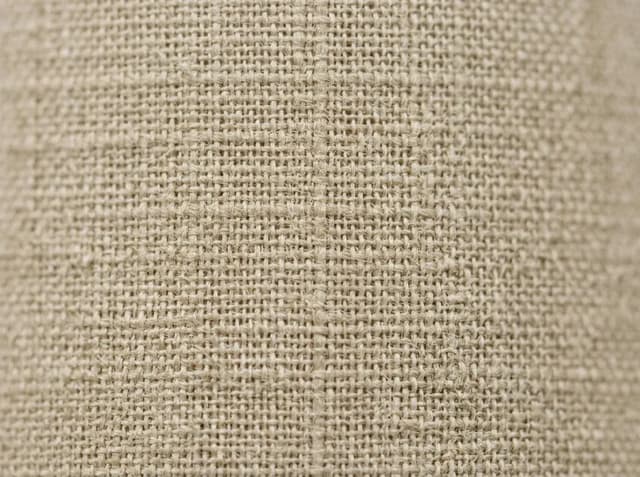
Polyester is a fibre, not a fabric. Every "type of polyester fabric" is the same polymer put through a different machine: a yarn choice, a weave plan and a finishing route. Change those three and one PET chip becomes a crisp curtain taffeta, a brushed bedding peachskin or a coated blackout that holds light at zero lux.
That is why the useful question is never "what type of polyester is this" but "what yarn, what weave, what finish, at what weight and width". This guide walks the three axes, then the eight woven families this mill runs, with what each one is bought for.
The short answer: three axes, not a list of names
Polyester fabrics are usually described as if they were species. They are combinations:
- Yarn — filament (FDY, DTY), or staple spun like cotton.
- Weave — plain, twill, satin, or a dobby programme.
- Finish — brushed, calendered, coated, embossed, dyed.
Two fabrics can share every chemistry and feel nothing alike. The table below is therefore a map of combinations this mill weaves, not a taxonomy of polyester.
The eight woven families
| Family | Construction | Hand | Bought for |
|---|---|---|---|
| Taffeta | Plain 1/1, FDY filament | Crisp, smooth, slightly lustrous | Curtains, linings, downproof shells |
| Pongee | Plain 1/1, DTY filament | Fine, soft, lightly crisp | Linings, thin shells, bedding bases |
| Peachskin | Plain weave, sanded | Velvety nap, soft | Bedding, soft-hand curtains |
| Twill | 2/1 or 2/2 diagonal | Softer drape, durable face | Upholstery, heavy home textiles |
| Sateen | Satin float, spun yarn | Silky face, sheen, drape | Bedding that wants lustre |
| Satin stripe | Satin floats on a plain ground (dobby) | Sheen bands, same colour | Hospitality bedding, decorative curtains |
| Dobby | Small geometric motifs, dobby shedding | Woven texture, not printed | Decorative bedding, upholstery grounds |
| Blackout | Dense base cloth, coated | Opaque, functional | Curtains, blinds, room dividers |
All eight run on the same waterjet battery — 650+ looms, greige at 160–330 cm, finished at 150–315 cm — which is why a programme can move between them without changing supplier.
Weights. Greige runs 55–120 GSM, finished roughly 60–140 GSM. Families sit inside that band: taffeta 50–85 GSM, peachskin 75–120, and a coated blackout finishes at 180–280 GSM because the coating is part of the weight. Always ask whether the quoted GSM is greige or finished — the number is not comparable across the two stages.
Yarn first: FDY, DTY and staple decide the hand
The yarn choice happens upstream, at the fibre plant, but it is fixed in the cloth.
- FDY (fully drawn) is smooth and strong — the crisp face of taffeta and many curtain bases.
- DTY (draw textured) has crimp and bulk — the softer, quieter hand of pongee, and the reason two fabrics with the same weave can feel different.
- Staple is filament cut and spun like cotton — a matte, cotton-like face instead of a glassy one, and a different pilling story.
The how polyester is made explainer follows that upstream chain; the yarn denier guide covers the numbering buyers put on a PO.
Weave second: plain, twill, satin, dobby
Weave is the part a buyer can see and touch:
- Plain — warp and weft cross one-to-one. Maximum yarn lock, the basis of taffeta and pongee.
- Twill — weft floats offset each pick, producing a diagonal wale. Denser, softer drape, tougher surface.
- Satin float — long floats on the face, giving sheen. Sateen uses spun yarn for a matte-lustre; satin uses filament for a brighter face.
- Dobby — a shedding programme that weaves small geometric motifs into the cloth. The pattern is structural: it cannot wash off, which is why hospitality programmes use it.
Finish third: what the cloth is after the loom
Finish is where two fabrics of identical construction stop being identical:
- Brushed or sanded — peachskin's nap.
- Calendered — the flat, slightly glazed face of lining and downproof cloth.
- Coated — blackout and water-repellent programmes; the coating is what adds weight and function.
- Embossed — heat and pressure on engraved rollers for a three-dimensional face.
- Dyed or printed — colour applied after weaving, with the fastness route named on the PO.
What each family is bought for
- Bedding — peachskin, sateen, satin stripe, dobby; plain pongee for budget bases. See bedding fabric types.
- Curtains and drapery — blackout, taffeta, pongee linings, peachskin for softness. See curtain fabric types, and wide-width greige for panels that must cut without a seam.
- Upholstery and heavy home textiles — twill and dobby grounds, where the weave's durability matters more than the hand.
- Linings and pocketing — taffeta and pongee, specified by denier and finish rather than by marketing name.
If the programme is functional rather than decorative — blackout, stain resistance, antibacterial, moisture-wicking — the finish is the product, and it should be specified as one.
What to write on the purchase order
A type name alone is not a specification. The line that gets quoted correctly carries:
- Yarn — FDY, DTY or staple, with denier.
- Weave — plain, twill, satin ratio, or dobby motif with repeat.
- Weight and stage — GSM, and whether greige or finished.
- Width — greige width and cuttable finished width.
- Finish — brushed, calendered, coated, embossed, or functional, with the standard.
- Programme terms — stock greige carries no minimum; custom greige starts at 5,000 m, dyeing at 3,000 m per colour.
That six-line discipline is the difference between a sample that matches and one that "looks close". Our greige programme shows the base cloths all eight families are built on; request a quote when the specification is ready.
Three things people get wrong
"Polyester is one fabric." It is one fibre. Taffeta and blackout are as different as cotton poplin and canvas.
"Type names are standardised." They are not. "Satin" may mean filament satin or spun sateen; "dobby" may mean a 1 cm stripe or a full geometric ground. The construction and the spec sheet decide.
"Heavier means better." Weight is a fit, not a grade. A 60 GSM taffeta lining is right where a 120 GSM peachskin would be wrong, and a 200 GSM blackout is right only because coating is part of its job.