Quality Control in Textile Manufacturing: Inside Our 200,000m/Day Production
When a textile mill reaches an annual output of 73M+ meters, quality control can no longer rely on sporadic checks; it must be engineered into the production line itself. At Weaverine Textile's main Anhui facility, managing a daily output of 200,000+ meters requires a rigorous, multi-stage quality assurance protocol.
For international buyers, consistency is just as critical as price. Here is a look inside the systematic quality control processes that govern our 31,000+ square meter facility.
1. Upstream Preparation: Warping and Drawing-in
Quality begins long before the looms start running. We operate 4 advanced warping machines (牵经车) and 2 drawing-in machines (穿棕机). During the warping process, yarn tension is continuously monitored to ensure a uniform beam. Uneven tension at this stage is the leading cause of defects like warp streaks in finished fabrics. By strictly controlling the preparation phase, we eliminate the root causes of weaving errors.
2. On-Loom Monitoring
Our production floor houses 650+ waterjet looms operating continuously. Throughout the weaving process, our technicians conduct systematic patrols. The machinery is equipped to automatically halt if a warp or weft yarn breaks, preventing the production of defective greige fabric.
Because we weave both plain and twill structures, loom settings are strictly calibrated for each specification—whether weaving a lightweight 55 GSM fabric or a heavier 120 GSM base.
3. Dedicated Inspection and Rolling
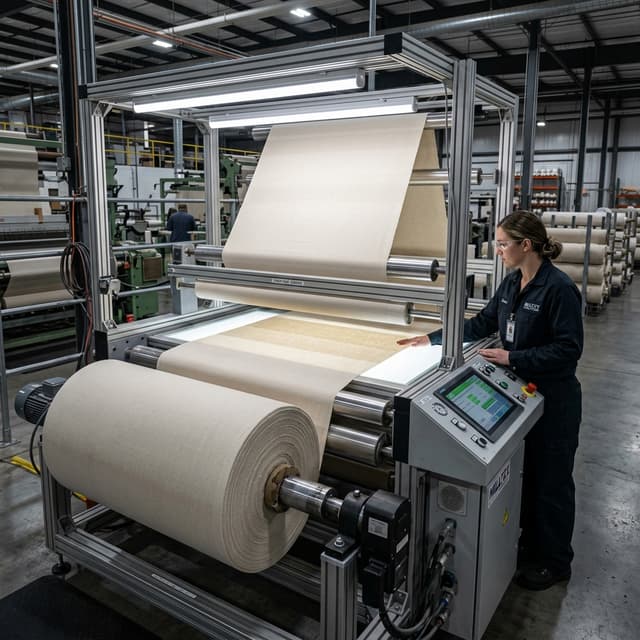
The most critical stage of our quality control happens after weaving and finishing. Weaverine operates 10 dedicated rolling and winding machines (打卷机), which serve as our primary inspection stations.
As the fabric is wound into rolls for shipping or transferred to the dyeing and printing workshops, trained inspectors evaluate the fabric over illuminated inspection boards. They are looking for:
- Weaving defects (e.g., broken picks, slubs, holes)
- Dyeing inconsistencies and color fastness (verified to Grade 3-4 for standard dyeing, and Grade 4-5 for digital printing)
- Correct width and weight specifications (ensuring finished widths fall accurately within the 150-315cm range)
4. Certification and Compliance Verification
Beyond visual and structural inspection, our quality extends to environmental and safety compliance. We maintain strict protocols to ensure our fabrics meet the standards required for our GRS (Global Recycled Standard) and OEKO-TEX® STANDARD 100 certifications. This ensures that every meter of fabric we export is free from harmful substances and meets international safety benchmarks.
The Value of Factory-Direct Consistency
For procurement managers sourcing home textiles, unpredictable quality can ruin profit margins through returns and unusable inventory. By partnering with a factory-direct mill that controls the process from yarn texturizing to final rolling, buyers mitigate their sourcing risks.
Contact us to learn more about our production capabilities and how our quality assurance processes can support your brand's strict standards.